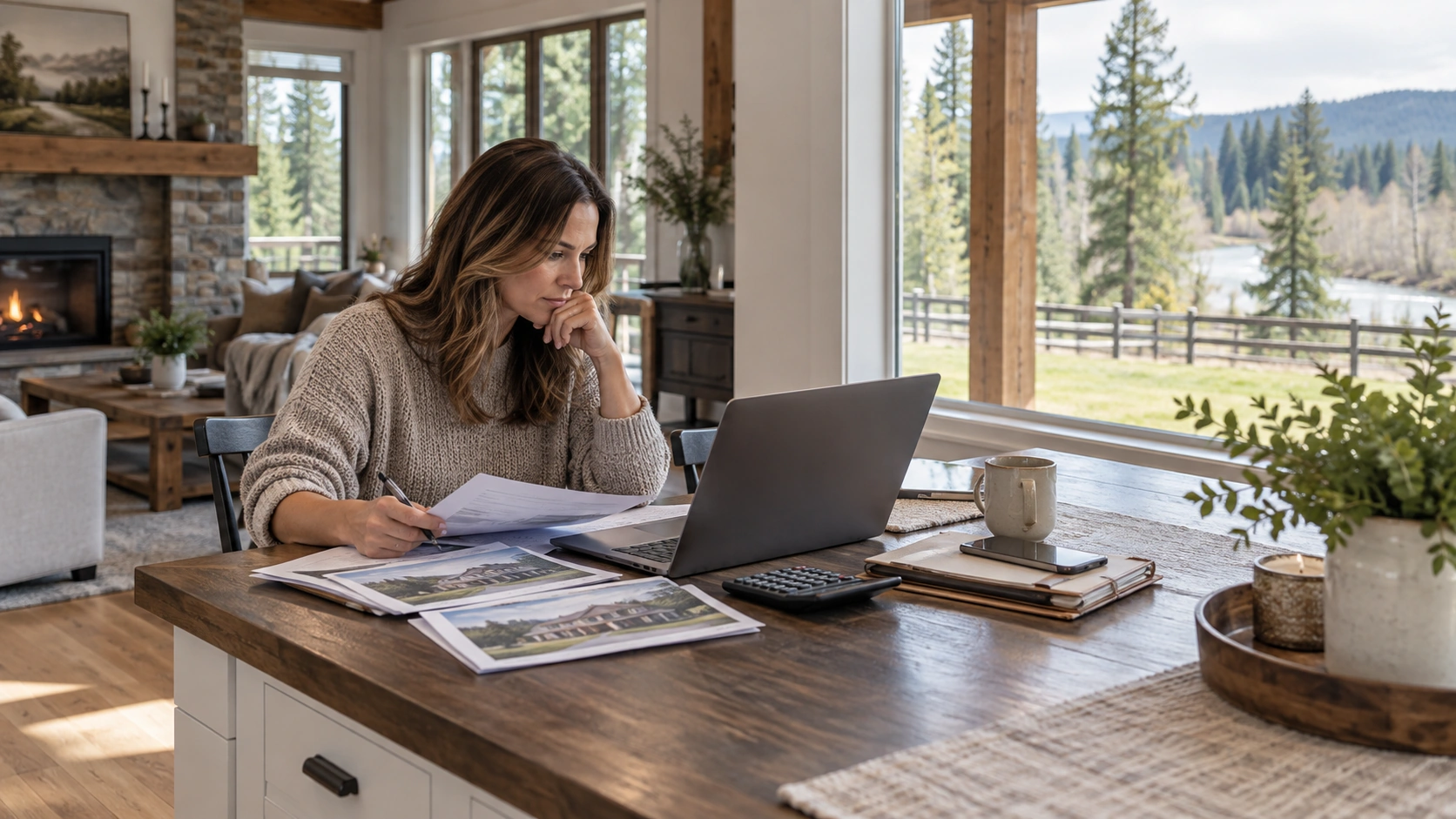
Salmon River, Langley Township, BC has no published benchmark price of its own, and never has. The Fraser Valley Real Estate Board reports Langley as a single zone covering both Langley Township, BC and Langley City, BC. What can be known honestly is the housing mix north of 56 Avenue — acreage, detached homes, private wells and septic systems — and what that mix does to a budget.
Start with what is not published
Most pages answering this question hand you a number. That number is almost always an estimate wearing the clothes of a statistic, and here the disguise is thinner than usual.
The Fraser Valley Real Estate Board publishes MLS® Home Price Index benchmarks for a fixed list of reporting zones. Langley is one of them — one zone, undivided. There is no separate benchmark for Langley Township, BC and Langley City, BC, and none for any sub-area inside either of them, including Salmon River. That is not a gap in this post; it is a gap in the data, and it has always been there.
So there is no sub-area figure here, because producing one would mean inventing it. Not a range, not an adjusted number, not a "typically around". A fabricated number is worse than no number, because you would plan against it. What follows instead is the published zone data with its date attached, an honest account of how badly that data fits this corner of the Township, and then the part that actually moves a budget out here.
What the published benchmarks actually cover
These are the current published MLS® HPI benchmark prices for the Langley zone, from the Fraser Valley Real Estate Board's August 2026 statistics package. They cover Langley Township, BC and Langley City, BC together, every neighbourhood in both, blended into one figure per segment.
Two notes. August 2026 is the most recent reporting month the board has published, so anything presented to you as an August figure does not exist yet. And detached here is the priciest of the western zones — $139,700 above the Cloverdale, Surrey, BC detached benchmark of $1,339,700 — while townhouse, at −5.0%, is among the most resilient segments anywhere in the board's zone table.
For the market these figures sit inside: the Fraser Valley recorded 941 MLS® sales in August 2026, up 1% year over year, with a sales-to-active-listings ratio of 10%. Balanced is 12% to 20%. Below that is a buyer's market, and prices are falling in every zone and every property type. That is the condition, not a deadline.
Why that benchmark fits this area worse than almost anywhere
This is the most useful thing this post can tell you.
An HPI benchmark is built from the stock that actually trades in a zone, and this zone's detached figure is built overwhelmingly from serviced suburban houses — subdivision lots on municipal water and sewer. The typical property in Salmon River, Langley Township, BC is not that. It is a detached home on acreage, on a private well, with its own septic system, in a rural planning area the Township itself designates the Salmon River Uplands.
Those are not two versions of the same product. They are different assets: land quantity, servicing, permitted use and financing all differ. A benchmark built mostly from the first will not describe the second in either direction — it is not the zone number plus a premium, and it is not the zone number minus a discount. It is not measuring the same thing.
So treat the $1,479,400 detached benchmark as what it is: a reading on which way the wider market across Langley Township, BC and Langley City, BC is moving. Useful for direction, useless for valuation out here. Anyone quoting you a precise figure for this area, or an acreage-adjusted version of the zone number, is quoting you arithmetic they did themselves.
The housing mix that sets your budget here
Land is the product
The stock in Salmon River, Langley Township, BC is predominantly detached homes on acreage. Local planning commentary and area profiles describe Township policy permitting subdivision down to about one acre, with most existing parcels running between one and five acres, and lot sizes ranging from small to genuinely farmable because much of the area was developed before the 1970s Agricultural Land Reserve designation arrived.
That reorders the budget conversation. In a serviced subdivision you are largely buying a house and the lot is a modifier; here the acreage is frequently the larger share of the value and the house is the modifier. Two properties a few hundred metres apart on 232 Street or 240 Street can differ enormously in usable land while presenting nearly identical square footage indoors.
Well and septic, not municipal service
Almost every property in Salmon River, Langley Township, BC is on a private well with a septic system rather than municipal water and sewer, according to consistent area sourcing. That should shape how you budget, not just how you picture the place.
Utility billing looks different from a serviced Township address — water is not metered by the municipality and there is no sewer charge — but testing, maintenance and eventual replacement of both systems sit with the owner. The due-diligence list is also longer. Well-flow testing and septic inspection are standard purchase conditions on properties like these, carried out by qualified inspectors and well professionals, and they belong in the subject clauses your REALTOR® and your lawyer or notary draft together, not in an assumption that the systems are fine because the taps ran during the showing.
There is almost nothing else to buy
Area sources describe no townhome or condominium developments in this part of the Township. Whatever the budget, the product in Salmon River, Langley Township, BC is a detached house on land.
The consequence is blunt: the $806,400 townhouse benchmark and the $534,000 apartment benchmark, as of August 2026, describe zone product that sits somewhere else entirely. There is no entry-level rung here to step onto, and patience does not change that, because the inventory does not exist to be waited for.
The Agricultural Land Reserve sits underneath much of it
Part of the Salmon River Uplands, in Langley Township, BC, is inside the Agricultural Land Reserve, and area sourcing describes most parcels as one- to five-acre holdings within it. ALR status is a provincial land-use designation governing what may be built and how land may be used, and it varies parcel by parcel.
That is not something to settle from a listing description. What may be done on a specific parcel is confirmed against the Agricultural Land Commission's own mapping and answered, in writing, by a real-estate lawyer and the Township's planning department for that exact legal description, before subjects are removed. It is a legal question, and worth paying a lawyer to answer properly.
How this area sits against the rest of Langley Township, BC
Without a published sub-area figure, the honest positioning statement is about mix rather than price — and it is still useful.
An area made up almost entirely of detached homes on one- to five-acre parcels has a higher floor than one that also offers townhouses, apartments and small suburban lots, because there is simply less inexpensive product in it. That is arithmetic about inventory, not a price quote. The ceiling is wide open, because land quantity varies so much: the same area holds modest older houses on small acreages and substantial homes on parcels several times the size.
Carrying costs run on the same Township-wide basis as everywhere else — the 2026 Class 1 residential rate is 3.61686 per $1,000 of assessed value, all authorities included — but a bill is rate times assessment, and acreage assessments are their own conversation.
Access is highway-oriented rather than transit-oriented. Salmon River, Langley Township, BC sits between Highway 1 and Glover Road, north of 56 Avenue, and Willowbrook Shopping Centre — the nearest full-scale retail concentration — sits where Fraser Highway meets 200 Street and Highway 10, straddling the Township and City line. Plan on driving for essentially everything, and treat that as fixed rather than as something a future project changes. The Surrey–Langley SkyTrain does not come here: the line runs the Fraser Highway corridor and terminates at 203 Street in Langley City, BC, with no station anywhere in this part of the Township.
Who buys here and why
Buyers who focus on Salmon River, Langley Township, BC are shopping for land more than for a house type. The stock is overwhelmingly detached homes on acreage with no townhouse or apartment inventory to fall back on, so the people who look here are the people who have already decided that the land is the point.
In practice that tends to mean households buying a property rather than a floor plan, and often households combining more than one generation under one roof, because larger homes on larger parcels accommodate that in a way a subdivision lot does not. Where two or more households buy together, ownership structure and financing are worth settling with a lawyer or notary and a mortgage broker before anyone writes an offer — title, succession and how a shared purchase is financed are their questions, and answering them late is expensive.
It also tends to mean buyers comfortable with maintenance. Williams Park at 64 Avenue and 238 Street, with the Salmon River running through it, is the local green space rather than a walkable retail street, and development interest — including a proposed housing site on more than 100 acres near 240 Street and 56 Avenue, next to the Tall Timbers golf course — changes a rural area slowly and is worth following if you are buying to hold.
What actually sets the price on a specific property
The variables that move the number here are not the ones that move it in a subdivision.
Usable acreage, not just acreage. Parcel size is the headline; how much of it is level, dry, cleared and actually usable is the price.
The condition of the well and the septic system. Two properties can look identical and differ by a five-figure sum in deferred servicing work. That is what the inspection period is for.
What the ALR designation permits on that parcel. Confirmed in writing, per parcel, by a lawyer and the Township — never assumed from a neighbour's setup.
The house and its vintage. Because much of the area predates the 1970s, the stock ranges widely in age and in how much of it has been renewed.
Highway access. Proximity to Highway 1 and Glover Road cuts both ways, convenience against noise, and it shows up in pricing.
None of those are visible in a zone benchmark. All of them are visible in comparable sales of similar acreage properties, which is what a real valuation is built from.
Getting a real number
If you want to know what a specific property here is worth, that is a conversation about recent comparable sales of similar parcels, not a figure lifted from a zone-wide index. It costs you nothing.
In the meantime you can browse Salmon River homes for sale, or widen it to Langley Township, BC homes for sale, which covers every neighbourhood in the municipality.
Frequently Asked Questions
Is there a published benchmark price for Salmon River, Langley Township, BC?
No. The Fraser Valley Real Estate Board publishes MLS® Home Price Index benchmarks for the Langley zone as a whole — a single zone covering both Langley Township, BC and Langley City, BC — and has never broken out sub-areas within it. Any precise figure quoted to you for this area is someone's estimate, not a published statistic.
What benchmark prices does the Fraser Valley Real Estate Board publish for this part of the Fraser Valley?
As of August 2026, the FVREB benchmarks for the Langley zone are $1,479,400 for a detached home, down 7.1% year over year; $948,600 composite, down 6.6%; $806,400 for a townhouse, down 5.0%; and $534,000 for an apartment, down 8.8%. Those cover Langley Township, BC and Langley City, BC together. For context, the Fraser Valley recorded 941 MLS® sales in August 2026, up 1% year over year, at a sales-to-active-listings ratio of 10% against a balanced range of 12% to 20%.
Why is the zone detached benchmark a poor guide to an acreage property in Salmon River, Langley Township, BC?
Because the benchmark is built largely from serviced suburban detached houses on subdivision lots with municipal water and sewer, and the typical property in this area is a detached home on one to five acres with a private well and a septic system. Those are different assets, not two versions of the same one, so the zone figure is useful for direction and unreliable for valuation here, in either direction.
Can you buy a townhouse or an apartment in Salmon River, Langley Township, BC?
Effectively no. Area sources describe no townhome or condominium developments in this part of Langley Township, BC, so the $806,400 townhouse and $534,000 apartment benchmarks as of August 2026 describe product that sits elsewhere in the zone. A buyer whose budget lands near either figure will be looking at another part of the Township or at Langley City, BC.
What should I budget for beyond the purchase price on an acreage property in Salmon River, Langley Township, BC?
Servicing and land are the two lines a serviced-suburb budget does not carry. There is no municipal water metering or sewer charge, but well and septic testing, maintenance and eventual replacement sit with the owner, and acreage brings its own upkeep. Property tax runs on the Township-wide 2026 Class 1 residential rate of 3.61686 per $1,000 of assessed value, all authorities included, applied to the assessment on that specific parcel.
What determines the price difference between two similar-looking acreage properties in Salmon River, Langley Township, BC?
Usable land rather than total land, the condition of the well and septic system, what the parcel's Agricultural Land Reserve status permits, the age and renewal history of the house, and proximity to Highway 1 and Glover Road. None of those appear in a zone benchmark, and all of them appear in comparable sales of similar parcels.
Related Reading
Living in Salmon River, Langley Township, BC: What It's Actually Like
Cost of Living in Langley Township, BC: What Your Budget Buys
Best Neighbourhoods in Langley Township, BC: A Community Guide
About the Author
Working across Langley Township, BC and the wider Fraser Valley, Caroline Jeklin is a REALTOR® with Royal LePage Wolstencroft Realty. She received the Royal LePage President's Gold Award in 2025, placing her in the top 6–10% of agents in her local marketplace, and has been part of 57 transactions between 2021 and 2026, ranging from $302,000 to $4,200,000, as of August 2026. She wrote this one because an area with no published benchmark, and a housing type the zone index barely represents, is exactly where invented numbers do the most damage — the mix, the servicing and the land tell a buyer more about their budget than a figure nobody can source. Read more about Caroline Jeklin, or reach her directly at 604-319-5052 or caroline@carolinejeklin.com.

 The data relating to real estate on this website comes in part from the MLS® Reciprocity program of either the Greater Vancouver REALTORS® (GVR), the Fraser Valley Real Estate Board (FVREB) or the Chilliwack and District Real Estate Board (CADREB). Real estate listings held by participating real estate firms are marked with the MLS® logo and detailed information about the listing includes the name of the listing agent. This representation is based in whole or part on data generated by either the GVR, the FVREB or the CADREB which assumes no responsibility for its accuracy. The materials contained on this page may not be reproduced without the express written consent of either the GVR, the FVREB or the CADREB.