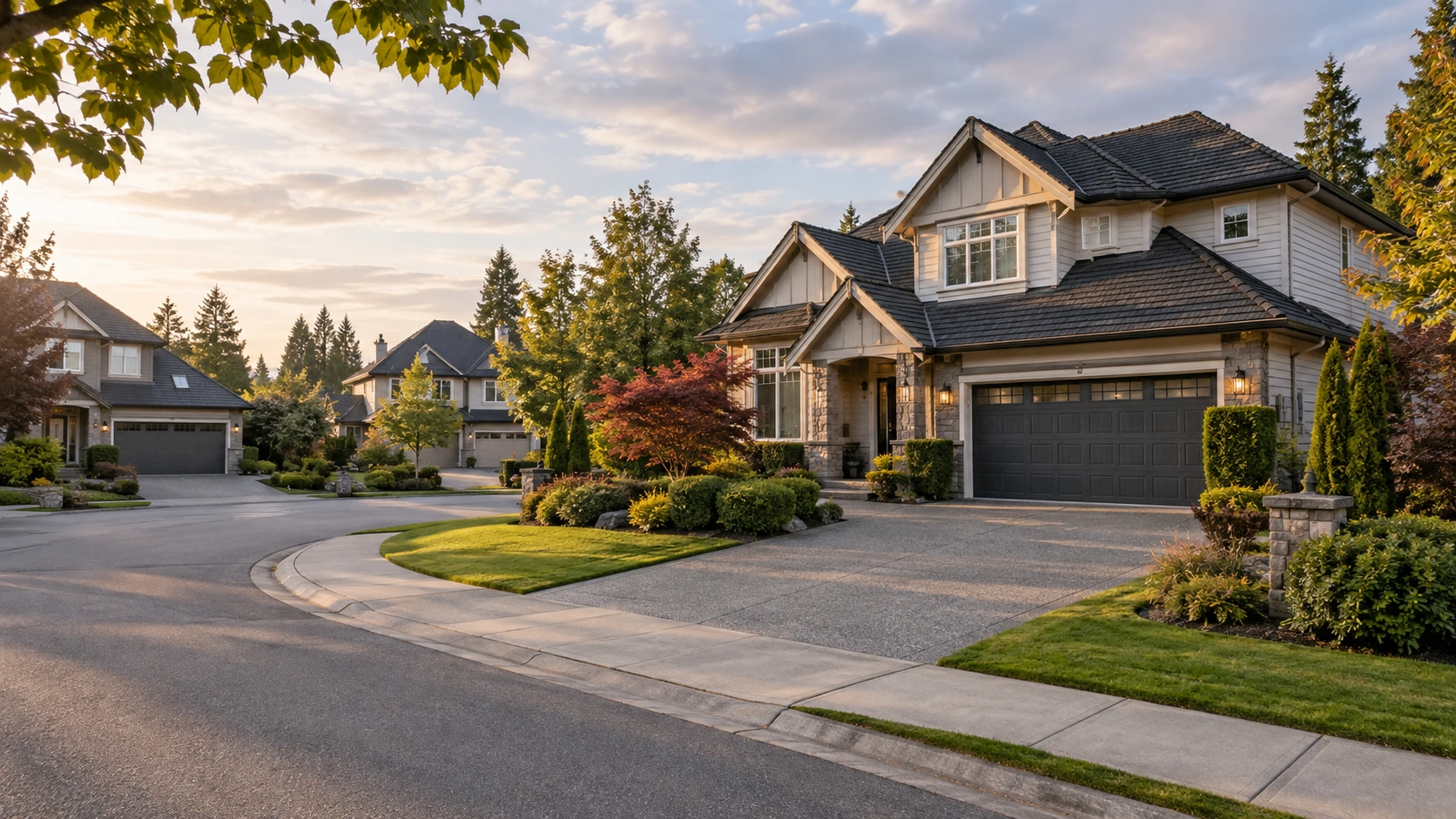
West Cloverdale, Surrey, BC has no published benchmark price of its own, and never has. The Fraser Valley Real Estate Board reports Cloverdale, Surrey, BC as one zone. What you can know honestly is the housing mix west of 168 Street — and that it splits at 60 Avenue, with larger lots and detached stock to the south, a genuine mix of townhomes and smaller-lot detached to the north — and what that does to a budget.
Start with what is not published
Most pages that answer this question give you a number. That number is almost always an estimate dressed up as a statistic, and it's worth understanding why before you plan around one.
The Fraser Valley Real Estate Board publishes MLS® Home Price Index benchmarks for a fixed list of reporting zones. Cloverdale, Surrey, BC is one of them. The quadrants inside it — the western one west of 168 Street, the older eastern streets, the historic core, and Clayton Heights, Surrey, BC — are not reported separately. There is no benchmark published for West Cloverdale, Surrey, BC, none for East Cloverdale, Surrey, BC, and none for Downtown Cloverdale, Surrey, BC. That isn't a gap in this post. It's a gap in the data, and it has always been there.
So I'm not going to give you a sub-area figure, because I'd have to make it up. Not a range, not an "adjusted" number, not a "typically around". A fabricated number is worse than no number, because you'd plan against it.
What I will do is give you the published Cloverdale-wide figures with their date attached, and then spend the rest of this post on the thing that actually moves your budget in this part of the community: the mix.
The Cloverdale, Surrey, BC benchmarks, August 2026
These are the current published MLS® HPI benchmark prices for the Cloverdale zone as a whole, from the Fraser Valley Real Estate Board's August 2026 statistics package. They cover all four quadrants together.
Two things about that table are worth reading carefully.
The first is the date. August 2026 is the most recent reporting month FVREB has published. Anything presented to you as an August figure for this area does not exist yet.
The second is the detached line. Down 6.3% over the year sounds like a decline, and it is — but across the Fraser Valley it is the shallowest detached decline in the board's zone table. Surrey-Central detached is down 8.8% over the same period, South Surrey and White Rock detached is down 7.5%, and the Fraser Valley Board overall is down 8.3%. Cloverdale detached has fallen at a meaningfully slower rate than its neighbours. For a buyer looking at the western quadrant — which is overwhelmingly detached — that is the most relevant single fact in the whole package.
For context on the market these figures sit in: the Fraser Valley recorded 941 MLS® sales in August 2026, up 1% year over year, with a sales-to-active-listings ratio of 10%. Balanced is 12% to 20%. Below that is a buyer's market, and prices are falling in every zone and every property type. I'm naming the condition, not a deadline.
The housing mix that actually sets your budget here
This is the part nobody writes, and it's the part that answers the real question.
It skews detached, hard
The stock west of 168 Street is dominated by detached, single-family houses. Most of it went in from the late 1990s onward, after the City of Surrey approved neighbourhood concept plans for the area's two halves, split at 60 Avenue, in 1997. The city now describes both as largely complete.
That has a direct budget consequence. In a quadrant where the overwhelming majority of what trades is detached, the Cloverdale, Surrey, BC composite benchmark of $930,900 — which blends detached, townhouse and apartment sales across all four quadrants — is the least useful number on the table for you. The detached benchmark of $1,339,700 is the one that describes the product actually being sold on these streets, and even that is a Cloverdale-wide figure, not a local one.
Lot sizes run larger, and that's most of the difference
Lots in this quadrant are larger than in most of the rest of Cloverdale, Surrey, BC, and the houses were built to fill them. Land is the single biggest input into a detached price in the Fraser Valley, so a larger lot in a finished, planned subdivision is not a small variable — it's usually the variable.
That's also why comparing a listing here to a listing in the older eastern streets on price alone will mislead you. You're often comparing two different quantities of land with a house on each.
The stock has a narrow, consistent vintage
Because the area built out over a defined window rather than across four decades, the housing has an unusually consistent age. Practically, that means fewer of the surprises that come with genuinely old stock — and it also means many of these homes are now at the age where roofs, hot water tanks and exterior finishes come due together. Read the inspection with that in mind and price the next decade of maintenance into your offer rather than into your regret.
What you won't find much of
Townhouse and apartment product is scarce south of 60 Avenue, where the stock is almost entirely larger-lot detached. North of 60 Avenue it is not scarce at all — established townhouse complexes including Arbour Village on 164 Street, Westfield on 166 Street and Turnberry on 168 Street run to a couple of hundred units between them, on smaller detached lots than the southern half. Across both halves, secondary suites and coach homes are far less common than in the newer, denser parts of Cloverdale, Surrey, BC built out in the 2000s and 2010s.
That matters to a budget in two directions. South of 60 Avenue there is very little entry-level way in — the $757,200 townhouse and $505,700 apartment benchmarks describe Cloverdale product that mostly sits elsewhere in the community, not on those streets. North of 60 Avenue the townhouse stock is the entry point, and it is the reason you can start here and move up without leaving the quadrant. And there's less mortgage-helper income built into the stock, so what you can carry is more likely to rest on your own household income alone than it would in Clayton Heights, Surrey, BC.
How this quadrant sits against the rest of Cloverdale, Surrey, BC
Without a published sub-area number, the honest positioning statement is a statement about mix, not price — and it's still useful.
A half made up almost entirely of larger-lot detached homes has a higher entry point than one that also offers townhouses, apartments and suited newer construction, because there is simply less inexpensive product in it. That is arithmetic about inventory, not a price quote. A buyer whose budget lands near the Cloverdale townhouse or apartment benchmark will usually find their options north of 60 Avenue, in Downtown Cloverdale, Surrey, BC, or in Clayton Heights, Surrey, BC — rather than on the larger-lot streets south of 60th.
The flip side is that the segment this quadrant is made of — detached — is the segment that has held up best in Cloverdale, Surrey, BC over the past year.
Who buys here and why
Who buys in West Cloverdale, Surrey, BC depends on which side of 60 Avenue they are looking at. South of 60th the buyer is almost always a move-up household with the budget for a large-lot detached house they intend to stay in, because there is very little else on offer. North of 60th the entry point is far lower — the townhouse stock gives a way in to someone who could not carry the southern half — and that difference decides where most people actually end up.
In practice, south of 60 Avenue that tends to mean move-up buyers rather than first-time ones, and households who have already decided which part of the Fraser Valley they want to be in. The everyday infrastructure across this side of Cloverdale, Surrey, BC supports that read — A.J. McLellan Elementary at 16545 61 Avenue sits inside the quadrant, Lord Tweedsmuir Secondary at 6151 180 Street is a short drive east, and Cloverdale Athletic Park at 6410 168 Street on the eastern edge carries a great deal of the organized sport in the community. Bose Forest Park at 6203 164 Street is the quieter counterweight.
It also means people right sizing out of a larger property sometimes find the southern half awkward, because the product there runs big. If you want less house and less yard but still want a house, the townhouse stock north of 60 Avenue is the place to look before you write off the quadrant altogether.
What actually sets the price on a specific house
Once you're looking at real listings, four things move the number far more than any area average would:
Lot size and shape. As above. It's the biggest single input, and it varies more within this quadrant than the streetscape suggests.
What backs onto it. The western and southern edges of the quadrant run along Agricultural Land Reserve farmland near 64 Avenue and 152 Street. A home whose rear boundary faces protected farmland is a different proposition from one facing another row of houses. What can and cannot be done on any particular ALR parcel is a question for a lawyer and the City of Surrey's planning department, asked in writing about that specific parcel before subjects are removed.
Whether it's been updated. In a stock of consistent vintage, the homes that have had kitchens, roofs and mechanicals done separate sharply from the ones that haven't.
Access. Highway 10 runs along the southern edge, Highway 15 along 176 Street handles north–south travel, and Fraser Highway cuts diagonally toward Langley City, BC and Langley Township, BC. Proximity to those routes cuts both ways — convenience on one side, road noise on the other — and it shows up in pricing.
None of those are visible in a benchmark. All of them are visible in comparable sales on the block, which is what a real valuation is built from.
Getting a real number
If you want to know what a specific home is worth, that's a conversation about recent comparable sales on those particular streets, not a figure lifted from a zone-wide index. It takes me an afternoon and it costs you nothing.
In the meantime, you can browse West Cloverdale homes for sale, or widen it to Cloverdale, Surrey, BC homes for sale, which covers all four quadrants.
Frequently Asked Questions
Is there a published benchmark price for West Cloverdale, Surrey, BC?
No. The Fraser Valley Real Estate Board publishes MLS® Home Price Index benchmarks for the Cloverdale, Surrey, BC zone as a whole and has never broken out the quadrants inside it. Any precise figure you're quoted for this sub-area is someone's estimate, not a published statistic.
What are the published Cloverdale, Surrey, BC benchmark prices right now?
As of August 2026, the FVREB benchmarks for the Cloverdale zone are $1,339,700 for a detached home, down 6.3% year over year; $930,900 composite, down 6.0%; $757,200 for a townhouse, down 6.4%; and $505,700 for an apartment, down 11.3%. Those are Cloverdale-wide figures covering all four quadrants.
Why would a home west of 168 Street cost more than one elsewhere in Cloverdale, Surrey, BC?
Because of the mix rather than any published premium. The quadrant is almost entirely larger-lot detached housing, with very little townhouse, apartment or suited newer product, so there's less inexpensive inventory in it than in quadrants that offer all of those. Land is also the largest single input into a detached price in the Fraser Valley, and lots here run larger.
Can you buy a townhouse or an apartment in West Cloverdale, Surrey, BC?
Very little of either exists west of 168 Street. Townhouse and apartment product is concentrated in the newer and more central parts of Cloverdale, Surrey, BC, so a buyer whose budget sits near the Cloverdale townhouse benchmark of $757,200 or the apartment benchmark of $505,700 as of August 2026 will usually find their options in another quadrant.
Is this a buyer's market or a seller's market in 2026?
A buyer's market, on the published numbers. The Fraser Valley recorded 941 MLS® sales in August 2026, up 1% year over year, with a sales-to-active-listings ratio of 10% against a balanced range of 12% to 20%, and prices falling across every zone and property type. Cloverdale detached has held up better than its neighbours, down 6.3% against Surrey-Central's 8.8%.
How do I find out what a specific home in West Cloverdale, Surrey, BC is worth?
Through comparable sales on that block, adjusted for lot size, condition, what the property backs onto and access to Highway 10 and Highway 15. A zone-wide benchmark can tell you which direction the market is moving; it can't value a house. That part starts with the address.
Related Reading
Living in West Cloverdale, Surrey, BC: What the Area Is Actually Like
Cost of Living in Cloverdale, Surrey, BC: What Your Budget Buys
About the Author
Caroline Jeklin is a REALTOR® with Royal LePage Wolstencroft Realty, working across Cloverdale, Surrey, BC and the wider Fraser Valley. She received the Royal LePage President's Gold Award in 2025, placing her in the top 6–10% of agents in her local marketplace. Licensed in 2021, she has been part of 57 transactions between 2021 and 2026, ranging from $302,000 to $4,200,000, as of August 2026. She wrote this one because the price question for a quadrant with no published benchmark gets answered with invented numbers more often than not, and the housing mix is a better guide to a budget than a figure nobody can source. Read more about Caroline Jeklin, or reach her directly at 604-319-5052 or caroline@carolinejeklin.com.

 The data relating to real estate on this website comes in part from the MLS® Reciprocity program of either the Greater Vancouver REALTORS® (GVR), the Fraser Valley Real Estate Board (FVREB) or the Chilliwack and District Real Estate Board (CADREB). Real estate listings held by participating real estate firms are marked with the MLS® logo and detailed information about the listing includes the name of the listing agent. This representation is based in whole or part on data generated by either the GVR, the FVREB or the CADREB which assumes no responsibility for its accuracy. The materials contained on this page may not be reproduced without the express written consent of either the GVR, the FVREB or the CADREB.
Comments:
Post Your Comment: