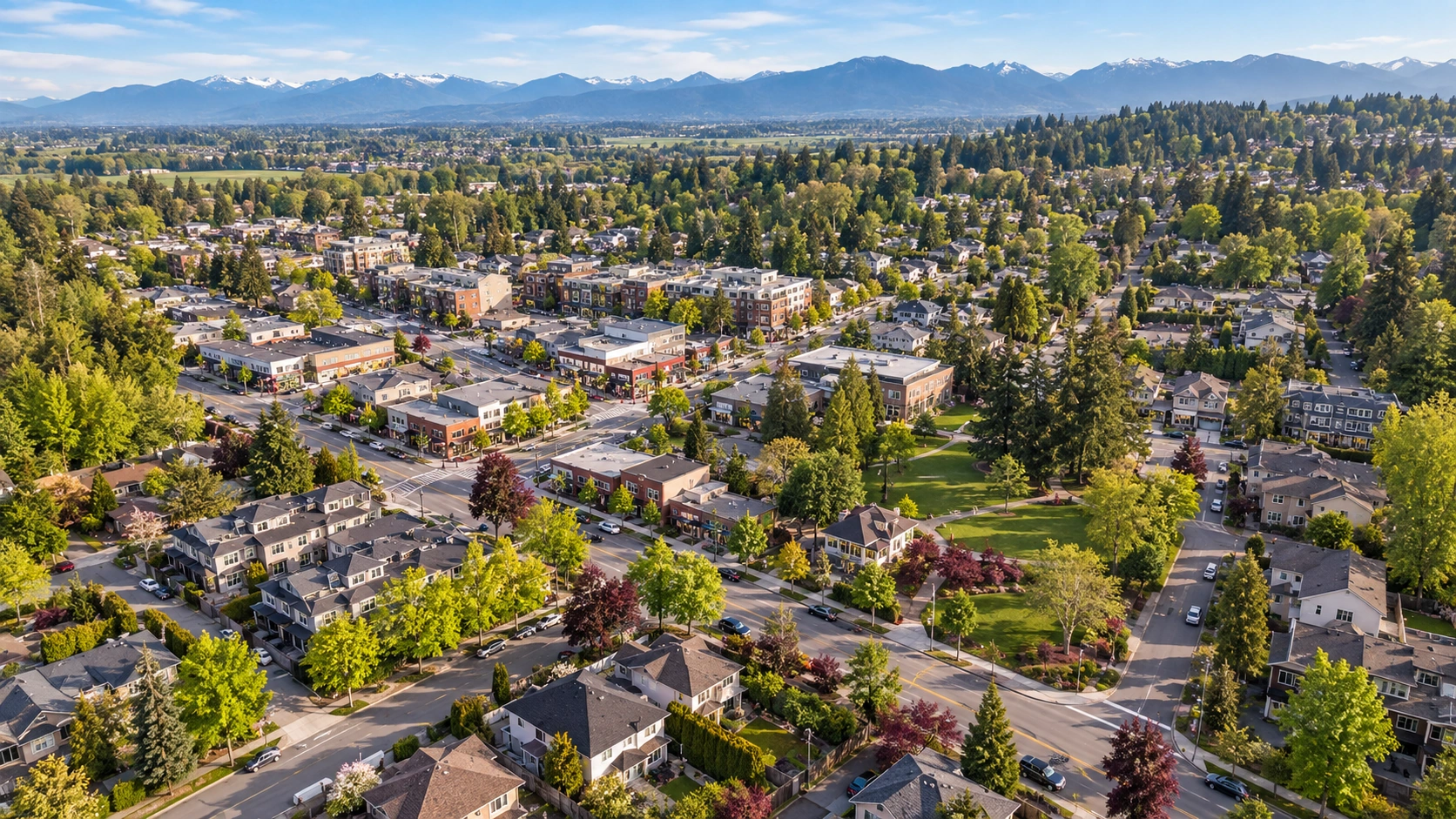
Homes in Downtown Cloverdale, Surrey, BC are priced against the Cloverdale zone as a whole, because no benchmark exists for the quadrant itself. Downtown Cloverdale is one of four quadrants of Cloverdale, a neighbourhood of Surrey, and its housing mix — older detached, townhouse and low-rise apartment — is what actually sets your budget here.
There is no published benchmark for this quadrant, and there never has been
Start with the thing most area guides quietly skip.
The Fraser Valley Real Estate Board publishes MLS® Home Price Index benchmarks by zone. Cloverdale, Surrey, BC is one zone. It is not broken into quadrants, so there is no Downtown Cloverdale, Surrey, BC benchmark, no East Cloverdale benchmark, no West Cloverdale benchmark and no Clayton Heights benchmark. That is not a gap that will be filled next quarter — those sub-area figures have never been published.
So when a page tells you the "average price in Downtown Cloverdale," one of two things is happening. Either it is quoting the Cloverdale zone number without saying so, or somebody has averaged a handful of recent sales and called the result a benchmark. In a quadrant this small, across a housing stock this mixed, that average swings on which four homes happened to close that month.
I'm not going to invent a number for you. What I can do is give you the real Cloverdale-wide figures, tell you honestly what they cover, and then describe the housing mix here well enough that you can work out where inside that range your own search sits. That last part is the useful bit, and it's the part nobody writes.
The Cloverdale, Surrey, BC benchmarks, August 2026
These are the Fraser Valley Real Estate Board MLS® HPI benchmark prices for the Cloverdale, Surrey, BC zone, August 2026. They cover all four quadrants together, including Downtown Cloverdale, Surrey, BC — not this quadrant on its own.
Two things sit underneath that table.
Cloverdale detached has held up better than its neighbours. At −6.3% over the year, detached here fell more slowly than Surrey-Central at −8.8% and South Surrey & White Rock at −7.5%, and better than the Fraser Valley Board's −8.3%. Note that "Surrey" in the board's reporting means Surrey-Central, a separate zone — there is no all-of-Surrey benchmark to compare against.
Apartments are the opposite story. At −11.3%, the Cloverdale apartment benchmark fell further over the year than any other segment in the board's table. That matters here more than in the other three quadrants, because this is where most of Cloverdale's low-rise apartment stock actually is.
For context on the wider market: across the Fraser Valley in August 2026, the sales-to-active-listings ratio was 10%, against a balanced range of 12% to 20%, on 941 MLS® sales — up 1% year over year, with prices down in every zone and every property type. That is a buyer's market by the board's own measure. I'll name the condition and leave the timing to you; there's no deadline in it.
The housing mix here is what actually moves your budget
This is where a quadrant-level answer is possible without inventing a quadrant-level price.
Cloverdale, Surrey, BC as a whole reads as a detached-home neighbourhood, and the zone benchmark reflects that. Downtown Cloverdale, Surrey, BC is the exception inside it. The band between 168 Street and 176 Street carries a genuinely mixed stock:
Post-war and mid-century detached homes on modest lots, particularly on the streets close to the commercial core. Smaller lots than West Cloverdale, Surrey, BC, and older systems.
Low-rise apartment buildings of three and four storeys, concentrated near 176 Street and 60 Avenue. This is the most apartment-heavy quadrant of Cloverdale.
Townhouse complexes from several build eras, from the 1990s through recent infill.
Newer detached infill — houses built in the last fifteen years dropped onto older lots, occasionally next door to a home four decades older.
The practical consequence: the spread of what you can buy within a ten-minute walk is wider here than anywhere else in Cloverdale, Surrey, BC. The townhouse and apartment benchmarks in the table above are the ones that describe a large share of this quadrant's stock, while in West Cloverdale, Surrey, BC the detached line does almost all the work. Two buyers with very different budgets can both shop the same eight blocks, and that is unusual.
It also means the zone detached benchmark misleads here. A 1958 house on a modest lot and a 2019 infill build on the same street are both "detached in Cloverdale," and they are not the same purchase.
Who buys in this quadrant, and why
The buyers who end up in Downtown Cloverdale, Surrey, BC are usually the ones who have decided that being able to walk to the library, the recreation centre and a grocery store matters more to them than the extra land they would get further west. What makes that possible on more than one budget is the mix: this is the quadrant where new construction keeps being added on top of an older base, so there is more than one price of entry.
That trade — walkability for lot size — is the single clearest pattern in this quadrant, and it shows up across three quite different budgets.
People right sizing out of a larger family home. The mix is the whole point: there is an actual step-down option, in townhouse or low-rise apartment form, inside the same few blocks as the detached stock. In most of Cloverdale, Surrey, BC, right sizing means leaving the area. Here it doesn't have to.
First-time and single buyers. The apartment and townhouse stock near 176 Street and 60 Avenue is the most accessible entry point in Cloverdale outside Clayton Heights, Surrey, BC, and unlike the newer areas it comes with somewhere to walk to.
Buyers who want an older detached home on a smaller lot and are comfortable trading a newer build for a shorter walk and, usually, a lower purchase price than the equivalent square footage west of 168 Street.
Who tends not to buy here: anyone whose priority is a large lot, a workshop, or new construction. That buyer is better served in West Cloverdale, Surrey, BC or Clayton Heights, Surrey, BC, and I'd rather say so than spend a Saturday proving it.
Where I draw the line, and what "desirable" means without a number
When someone asks me where Downtown Cloverdale, Surrey, BC actually starts and stops, I give them the same two numbers: 168th to 176th. That band is the main middle ground of Cloverdale, Surrey, BC — not the newer construction out west, not the older compact grid across 176 Street — and I'd call it very desirable. I say that as a description of the area, not as a price. Desirable shows up in how often a buyer who started out looking at the whole neighbourhood narrows to those blocks once they've walked them. It does not show up in a benchmark, because no benchmark for those blocks exists. Anyone who tells you otherwise is quoting the zone and hoping you won't check.
What actually changes the price address to address
Inside a quadrant this mixed, the variables below move a number further than the quadrant boundary does.
Which street, and how far from Highway 15. 176 Street through the commercial core is Highway 15, the provincial route running south to the Pacific Highway border crossing, and it carries commercial truck traffic. A home a few streets off it and a home fronting it are different products. This is the most underreported price factor in the area.
Build era and what's been done since. With four or five vintages on a block, condition varies enormously. Roof, drain tile, electrical service and windows are the items that decide whether an older detached home here is a bargain or a project.
For stratas, the building's paperwork. On an older low-rise, the depreciation report, the reserve fund balance and the special levy history matter more to your real cost than the finish level of the kitchen. Read them before your subjects come off, not after.
Distance to the civic cluster. The Museum of Surrey, the Cloverdale Library, the Cloverdale Recreation Centre and the Cloverdale Fairgrounds are all within a short radius, and so is the Cloverdale Millennium Trail on the old rail alignment. Proximity to those is a real part of what people are paying for here.
Budgeting past the purchase price
A few costs that catch buyers out in this quadrant specifically.
Strata fees on older low-rise buildings. Lower monthly fees are not automatically cheaper. A building with modest fees and a thin reserve fund is deferring a bill, not avoiding one.
Older-home maintenance. On post-war and mid-century detached stock, budget for systems, not cosmetics. An inspection matters more here than in an area where everything went up in the same three years.
Property tax and utilities are set by the City of Surrey and apply across the municipality — check the current year's rate against the assessed value of the specific home rather than an area average.
Your deposit and financing are conversations for a mortgage broker and, on anything unusual, a lawyer or notary. I'll flag what to ask; I won't answer it for them.
How to get a number for your own search
There is no shortcut around the fact that the useful number is address-specific. What I'd do in your position:
Decide the housing type first. Detached, townhouse and apartment are three different markets in this quadrant, and the zone benchmarks above are the honest starting range for each.
Walk the band between 168 Street and 176 Street. Once on a weekday, once on a Saturday when the main street is busy. It's small enough that an afternoon settles a lot.
Look at what's actually listed, not what an area average implies. You can browse Downtown Cloverdale homes for sale, or the whole neighbourhood at Cloverdale, Surrey, BC homes for sale — and filter by street and property type.
Then get a real number on a real address. That's a twenty-minute conversation, and it beats any figure on any area page, including this one.
Frequently Asked Questions
Is there a published benchmark price for Downtown Cloverdale, Surrey, BC?
No. The Fraser Valley Real Estate Board publishes MLS® HPI benchmarks for the Cloverdale zone as a whole and does not break it into quadrants, so no Downtown Cloverdale benchmark exists and none ever has. Any page quoting a specific average for the quadrant is either repeating the Cloverdale, Surrey, BC zone figure without saying so, or averaging a small handful of recent sales, which is not the same thing.
What do the Cloverdale, Surrey, BC benchmarks say for someone buying in this quadrant?
For August 2026 the Cloverdale zone benchmarks were $1,339,700 detached (down 6.3% over the year), $757,200 townhouse (down 6.4%), $505,700 apartment (down 11.3%) and $930,900 composite (down 6.0%). Those cover all four quadrants together. They're the honest starting range by property type for Downtown Cloverdale, Surrey, BC, but they do not describe this quadrant specifically.
Is Downtown Cloverdale, Surrey, BC cheaper than the rest of Cloverdale, Surrey, BC?
There's no published figure that would let anyone answer that with a number, and I won't estimate one. What can be said is that the housing mix differs: this quadrant carries more townhouse and low-rise apartment stock than West Cloverdale, Surrey, BC, and its detached homes sit on smaller, older lots. That mix means the entry point by property type is lower here, which is not the same as the same home costing less.
What is the most accessible way into Downtown Cloverdale, Surrey, BC?
The low-rise apartment and townhouse stock, concentrated near 176 Street and 60 Avenue. It's the most accessible entry point in Cloverdale, Surrey, BC outside Clayton Heights, Surrey, BC, and it comes with walkable errands the newer quadrants don't offer. On any older strata, read the depreciation report, the reserve fund balance and the special levy history before your subjects come off.
Are prices rising or falling for buyers looking at Downtown Cloverdale, Surrey, BC?
Falling, across the board. In August 2026 the Fraser Valley Real Estate Board reported prices down in every zone and every property type, on 941 MLS® sales, up 1% year over year. The sales-to-active-listings ratio was 10%, below the balanced range of 12% to 20%. Cloverdale, Surrey, BC detached held up best at −6.3%; apartments there fell furthest at −11.3%.
What should I budget for beyond the purchase price in Downtown Cloverdale, Surrey, BC?
On older detached homes, systems rather than cosmetics — roof, drain tile, electrical service and windows. On older low-rise stratas, the monthly fee plus whatever the reserve fund is not currently covering. Property tax and utilities are set by the City of Surrey and should be checked against the specific home's assessed value. Deposit and financing questions belong with a mortgage broker.
Related Reading
Living in Downtown Cloverdale, Surrey, BC: What the Area Is Actually Like
Cost of Living in Cloverdale, Surrey, BC: What Your Budget Buys
About the Author
Caroline Jeklin is a REALTOR® with Royal LePage Wolstencroft Realty, licensed in 2021 and working across the Fraser Valley from Cloverdale, Surrey, BC. She has been part of 57 transactions in that time, at prices from $302,000 to $4,200,000 (2021–2026, as of August 2026), and carries 11 Google reviews from past clients. She spends a lot of her working life explaining why a zone benchmark is not an address, which is most of what this post is about — in Downtown Cloverdale, Surrey, BC, where a 1958 bungalow and a recent infill build can sit on the same street, that distinction decides whether a budget is realistic. You can read more about Caroline Jeklin's background and approach, or reach her directly at 604-319-5052 or caroline@carolinejeklin.com.

 The data relating to real estate on this website comes in part from the MLS® Reciprocity program of either the Greater Vancouver REALTORS® (GVR), the Fraser Valley Real Estate Board (FVREB) or the Chilliwack and District Real Estate Board (CADREB). Real estate listings held by participating real estate firms are marked with the MLS® logo and detailed information about the listing includes the name of the listing agent. This representation is based in whole or part on data generated by either the GVR, the FVREB or the CADREB which assumes no responsibility for its accuracy. The materials contained on this page may not be reproduced without the express written consent of either the GVR, the FVREB or the CADREB.
Comments:
Post Your Comment: