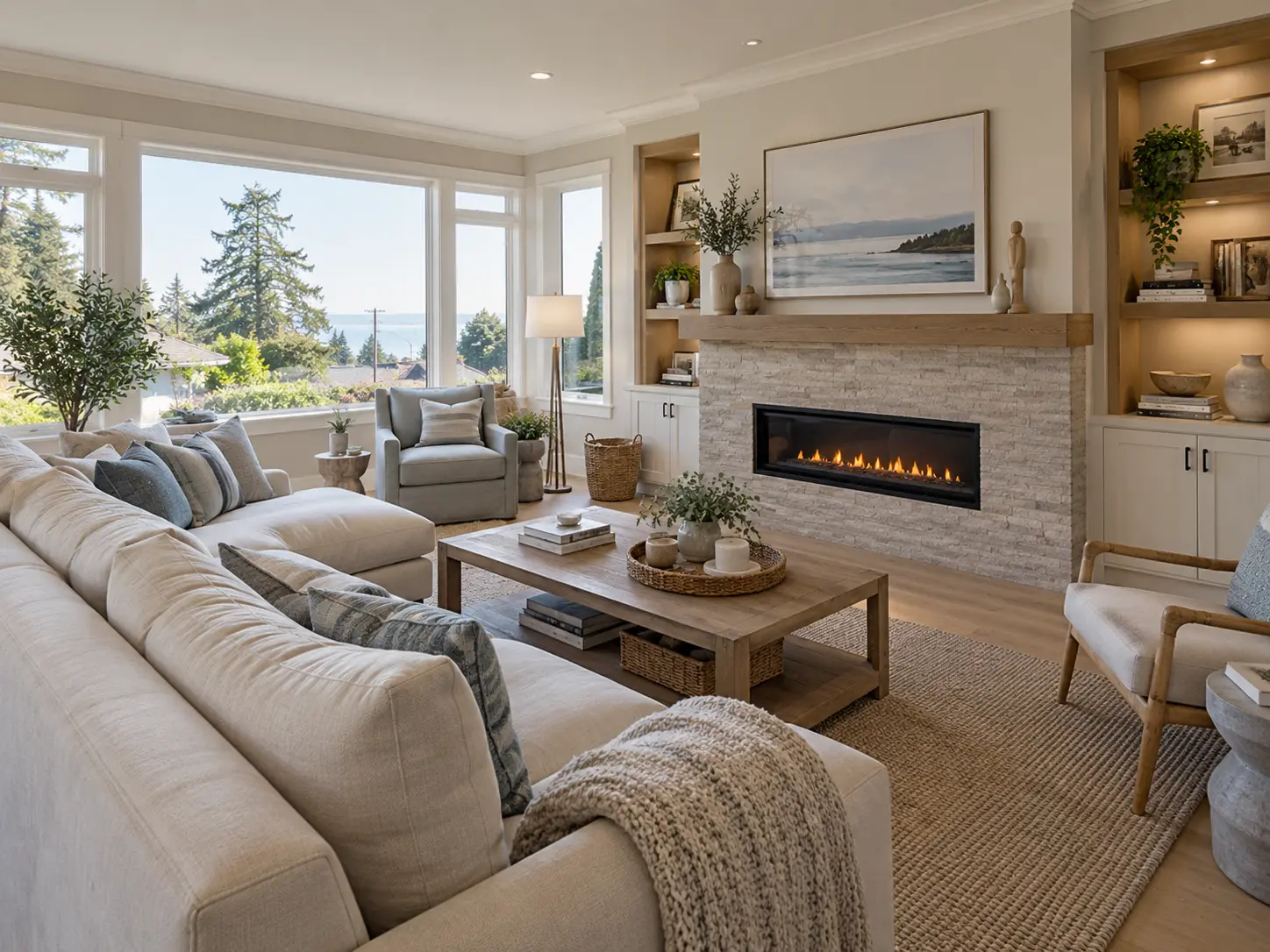
White Rock, BC has no benchmark price of its own and never has. The Fraser Valley Real Estate Board reports it inside a zone that also covers eight South Surrey sub-areas. What can be answered honestly is that zone figure, the housing mix on this 5.17 square kilometre hillside, and what the age of the stock does to a budget.
Start with what is not published
Most pages answering this question hand you a single number for the city. It is worth knowing where that number comes from.
The Fraser Valley Real Estate Board publishes MLS® Home Price Index benchmarks for a fixed list of reporting zones. One of them is South Surrey & White Rock — a single reporting unit covering the entire City of White Rock plus all eight South Surrey sub-areas beside it. The board has never broken the city out on its own, and none of those eight sub-areas is reported separately either. There is no published benchmark for White Rock, BC, no historical one, and no month in which there was. The gap is in the data, and it applies to every neighbourhood on this peninsula.
So no city-only figure appears below. Not a range, not an "adjusted" number, not a "typically around". An invented number is worse than an honest blank, because a buyer will plan against it and a lender will not. What follows is the published zone figure with its date attached, and then the thing that actually determines what a home here costs: what got built, when, and what that means before an offer.
What the board actually publishes, August 2026
These are the MLS® HPI benchmark prices from the Fraser Valley Real Estate Board's August 2026 statistics package, for the zone as a whole. They are zone-wide figures, spanning the City of White Rock and all eight Surrey sub-areas together — not figures for these streets.
Three things in that table are worth reading slowly.
The date. August 2026 is the most recent month the board has reported. Any August figure quoted for this area does not exist.
The zone is the board's most expensive. At $1,010,000 composite it sits above Langley at $948,600, Cloverdale at $930,900, Surrey-Central at $912,700 and North Surrey at $640,800, and its $1,649,200 detached benchmark is the board's highest as well. Buyers arriving from elsewhere in the Fraser Valley should expect that gap.
The townhouse line is the weakest townhouse segment on the board. Down 11.1% over the year, the zone's townhouse segment has fallen further than any other townhouse segment the board reports — further than Cloverdale at −6.4%, Surrey at −5.9% and Langley at −5.0%.
For the market these sit inside: the Fraser Valley recorded 941 MLS® sales in August 2026, up 1% year over year, at a sales-to-active-listings ratio of 10%. The board considers 12% to 20% balanced, with prices declining across every zone and property type. That describes the condition, not a deadline.
The housing mix that sets a budget here
This matters more than the zone average, because that average describes a mix this city does not have.
White Rock, BC is small, built out and vertical by the standards of everything around it — Semiahmoo Bay up to North Bluff Road at 16 Avenue, bounded by Bergstrom Road at 136 Street on the west and Stayte Road at 160 Street on the east, inside 5.17 square kilometres. There is no greenfield left, so anything new replaces something already standing.
The result is a market weighted toward apartments. On listing-site snapshots — a picture of what happens to be for sale on a given day, not board data and not a count of what exists — apartments make up the largest share of active inventory here, detached houses most of the remainder, and townhouses only a small slice. That is directional, not statistical, and the direction is the useful part: a buyer shopping this city is mostly shopping apartments.
Concrete and low-rise buildings with ocean views cluster near Marine Drive and the streets immediately above it. Older detached character homes sit further up the hill, on lots subdivided to the standards of their own era rather than today's.
That mix has a direct budget consequence. In a market made mostly of apartments, the zone composite of $1,010,000 — blending detached, townhouse and apartment sales across nine areas — is the least useful line on the table for most buyers here. The apartment benchmark of $550,800 describes the segment most of this city's sales sit in, and even that is a zone figure, not a local one. On the hillside the reverse holds: detached stock sits in the segment carrying a $1,649,200 zone benchmark, in a city where the lots are finite and were drawn decades ago.
Why building age is the price question nobody writes about
This is what almost every page about this market leaves out, and it changes what an apartment is worth more than any average will.
A large share of the low-rise apartment stock in White Rock, BC dates from the 1960s and 1970s, with older buildings behind that and newer concrete construction nearer the water. That describes the stock; it is not a criticism. Plenty of these buildings are well run, well reserved and on the best land in the city.
But age drives the questions that decide whether a unit is priced correctly:
The depreciation report. It projects the cost and timing of major component replacement. Its numbers, and how recently it was updated, tell you what is coming.
The contingency reserve fund. Its balance, measured against what the depreciation report says is due, is the difference between a planned replacement and a special levy.
Special levies — passed, proposed or discussed. An approved levy is a known cost. One still being talked about is a cost that has not arrived yet, and the minutes are where it shows up first.
Envelope history. When the building was rain-screened, if it was, and what the warranty situation is.
Component ages. Roof, windows, piping, elevator, boiler — these come due together in buildings of a common vintage.
None of that is legal or financial advice, and no blog post can assess it for a particular building. The registered strata documents are the source, and a lawyer or notary reads the legal implications. What is fair to state plainly: in a market this apartment-heavy and this old, two units with the same square footage, view and asking price can be worth materially different amounts once the documents are read. That difference is invisible in every benchmark ever published.
How this city sits against the rest of the zone
The zone benchmark blends White Rock, BC with eight Surrey sub-areas holding large-lot estate housing, golf-course communities, acreage and new-build subdivisions. This city contributes apartments and hillside detached homes, and almost none of the new detached product built inland. So the zone composite, read as a proxy for an apartment here, is a figure lifted by housing types that mostly are not in this city; read as a proxy for a hillside detached home, it is one pulled down by apartments that mostly are. That is arithmetic about what gets blended, not a claim about a local premium or discount.
Who buys here and why
Buyers who focus on White Rock, BC are, more often than not, shopping an apartment, because apartments are what most of this market is made of — and a large share of them are right sizing out of a detached house and yard somewhere else in the Fraser Valley. The mix is what selects for that: a small, built-out city with no room left to develop produces apartments and older hillside detached homes rather than the newer subdivision product that draws growing families across the line into Surrey.
The everyday infrastructure fits that read. White Rock Centre, the on-street bus exchange on the city's boundary with Surrey, is the southernmost transit hub in Metro Vancouver, with Route 351 running to Bridgeport Station via Highway 99. Peace Arch Hospital is inside the city. The White Rock Promenade runs between Bay Street and Finlay Street, with Semiahmoo Park where the beachfront ends and the White Rock Pier reaching roughly 500 metres into Semiahmoo Bay. Walkable waterfront, a hospital, a bus exchange and low-maintenance apartments is a coherent product, priced as one.
It fits less well where a budget depends on new construction, a large flat lot, or a suited home with rental income. That product is inland, in the Surrey sub-areas.
What actually sets the price on a specific home
Once real listings are on the table, five things move the number more than any zone average:
Strata or freehold. Apartment versus detached is not a preference here. It is two markets, two benchmarks and two entirely different due-diligence processes.
Building age and strata finances. As above — frequently the largest single swing factor on an apartment in this stock.
Elevation and outlook. The grade between the beach and North Bluff Road at 16 Avenue is real, and a view unobstructed today may depend on what can be built in front of it — a question for the city's own zoning and development records, asked about the specific site.
Distance to the promenade on foot. Walkability to Marine Drive is why a great deal of this stock trades at all, and it falls off block by block.
Condition. In a stock of consistent vintage, homes that have had kitchens, mechanicals and windows done separate sharply from those that have not.
None of that appears in a benchmark. All of it appears in comparable sales on the building or block.
Getting a real number
A figure for a particular home comes from recent comparable sales in that building or on those streets, read alongside the strata documents where there are any — not from a zone-wide index. Current inventory is browsable at White Rock homes for sale, or across the whole zone at South Surrey and White Rock, BC homes for sale. Pulling comparables for a specific address is a conversation, not a blog post.
Frequently Asked Questions
What is the FVREB benchmark price for the South Surrey & White Rock zone right now?
As of August 2026, the Fraser Valley Real Estate Board's MLS® Home Price Index benchmarks for the South Surrey & White Rock zone were $1,010,000 composite, down 7.2% year over year; $1,649,200 detached, down 7.5%; $820,300 townhouse, down 11.1%; and $550,800 apartment, down 6.2%. Those are zone-wide figures covering the City of White Rock together with all eight South Surrey sub-areas. The board publishes no figure for any one of them alone.
Why does the age of an apartment building in White Rock, BC change what a unit is worth?
Because a large share of the low-rise apartment stock here dates from the 1960s and 1970s, and building age drives costs already scheduled but not yet spent. The depreciation report, the contingency reserve fund balance, any special levy passed or under discussion, the rain-screening history and the ages of roof, windows, piping and elevator all sit in the registered strata documents. Two units with the same size, view and asking price can be worth quite different amounts once those are read, and a lawyer or notary reads the legal implications.
Is White Rock, BC more expensive than the rest of the Fraser Valley?
The zone it sits in is the most expensive the Fraser Valley Real Estate Board reports. As of August 2026 its composite benchmark of $1,010,000 was above Langley at $948,600, Cloverdale at $930,900, Surrey-Central at $912,700 and North Surrey at $640,800, and its detached benchmark of $1,649,200 was the board's highest. That compares zones, not cities — no city-level benchmark is published for White Rock.
Are prices in White Rock, BC rising or falling?
Falling, on the published figures. Every segment of the South Surrey & White Rock zone benchmark was down year over year as of August 2026, from −6.2% on apartments to −11.1% on townhouses. Board-wide, the Fraser Valley recorded 941 MLS® sales that month, up 1% from a year earlier, at a sales-to-active-listings ratio of 10% against a balanced range of 12% to 20%.
Why has the townhouse segment covering White Rock, BC fallen further than any other?
The reason is not published, but the fact is. At −11.1% over the year to August 2026, the South Surrey & White Rock townhouse benchmark of $820,300 is the weakest-performing townhouse segment in the Fraser Valley Real Estate Board's entire zone table, against Cloverdale at −6.4%, Surrey at −5.9% and Langley at −5.0%. Townhouses are also the smallest slice of what trades inside the City of White Rock.
How do I find out what a specific home in White Rock, BC is worth?
Through comparable sales in that building or on that block, adjusted for elevation and outlook, walking distance to Marine Drive and the promenade, condition, and — for an apartment — what the strata documents say about finances and deferred work. A zone benchmark shows which direction the market is moving. It cannot value a home, and on this stock it cannot see the variable that most often decides the price.
Related Reading
What Homes Cost in Crescent Beach and Ocean Park, South Surrey, BC
What Homes Cost in the King George Corridor, South Surrey, BC
About the Author
Caroline Jeklin received the Royal LePage President's Gold Award in 2025, placing her in the top 6–10% of agents in her local marketplace. She is a REALTOR® with Royal LePage Wolstencroft Realty, licensed in 2021, working across the Fraser Valley, and between 2021 and 2026 she has been part of 57 transactions ranging from $302,000 to $4,200,000, as of August 2026. She wrote this one because a city with no published benchmark of its own attracts invented numbers, and on stock this old the strata documents move a price more than any average does. Read more about Caroline Jeklin, or reach her directly at 604-319-5052 or caroline@carolinejeklin.com.

 The data relating to real estate on this website comes in part from the MLS® Reciprocity program of either the Greater Vancouver REALTORS® (GVR), the Fraser Valley Real Estate Board (FVREB) or the Chilliwack and District Real Estate Board (CADREB). Real estate listings held by participating real estate firms are marked with the MLS® logo and detailed information about the listing includes the name of the listing agent. This representation is based in whole or part on data generated by either the GVR, the FVREB or the CADREB which assumes no responsibility for its accuracy. The materials contained on this page may not be reproduced without the express written consent of either the GVR, the FVREB or the CADREB.
Comments:
Post Your Comment: